
Ligament Reconstruction Surgery: Treatment, Recovery Time & What to Expect
Ligament injuries are common among athletes, active adults, and people who experience sudden twisting movements, falls, or accidents. A torn ligament can cause pain, swelling, instability, and difficulty performing everyday activities. In some cases, rest, physiotherapy, medicines, and activity modification may be enough to manage the injury. However, when a ligament tear causes significant instability or affects a person’s ability to return to work, sports, or daily activities, surgery may be considered.
Ligament reconstruction surgery is an orthopaedic procedure used to restore stability when a damaged ligament cannot adequately perform its normal function. The procedure is commonly associated with knee injuries, particularly anterior cruciate ligament (ACL) injuries, although ligament reconstruction may also be performed for other joints depending on the injury and individual condition. During reconstruction, the damaged ligament is replaced or reconstructed using a suitable tendon graft or other surgical technique. The decision to undergo ligament injury treatment depends on several factors, including the location and severity of the tear, knee or joint instability, associated injuries, activity level, age, overall health, and treatment goals. A detailed clinical examination and appropriate imaging, such as MRI when indicated, help an orthopaedic specialist understand the injury and plan treatment. At Mediheal Hospital, patients with sports injuries and ligament problems can discuss their symptoms and treatment options with an orthopaedic specialist to understand whether conservative treatment, rehabilitation, ligament repair surgery, or ligament reconstruction is appropriate for their condition.
What Is a Ligament?
Ligaments are strong bands of connective tissue that connect one bone to another and help stabilize joints. They control excessive movement and help maintain proper alignment while walking, running, jumping, turning, and performing other activities. Several important ligaments are present around the knee. These include the anterior cruciate ligament (ACL), posterior cruciate ligament (PCL), medial collateral ligament (MCL), and lateral collateral ligament (LCL). The ACL is particularly important for controlling forward movement and rotational stability of the knee. A ligament can become stretched, partially torn, or completely torn. The severity of an injury and the ligament involved can influence whether non-surgical treatment or ligament reconstruction surgery is required.
What Causes a Ligament Injury?
Ligament injuries can occur during sports, exercise, accidents, or everyday activities. A sudden change in direction, awkward landing, twisting of the knee, direct impact, or excessive force on a joint can damage a ligament. Sports such as football, cricket, basketball, badminton, tennis, skiing, and other activities involving jumping, pivoting, or rapid changes in direction can increase the risk of certain ligament injuries. However, sports are not the only cause. Road accidents, workplace injuries, falls, and other traumatic events can also result in ligament damage. Some ligament injuries occur without direct contact. For example, an athlete may plant the foot while the body suddenly turns in another direction, placing considerable stress on the knee ligament. ACL injuries frequently occur through this type of twisting mechanism.
Common Symptoms of a Torn Ligament
The symptoms of a ligament injury can vary depending on the joint, ligament involved, and severity of the injury. Common symptoms may include pain around the affected joint, swelling, difficulty bearing weight, restricted movement, bruising, and a feeling that the joint is unstable. Some people with an ACL injury report hearing or feeling a “pop” at the time of injury. Rapid swelling of the knee may also occur. However, symptoms alone cannot confirm the type or severity of a ligament tear. Persistent instability is particularly important because repeatedly giving way can interfere with daily activities and sports and may be associated with additional damage to structures such as the meniscus or cartilage. A specialist assessment can help determine the appropriate ligament injury treatment.
How Is a Ligament Injury Diagnosed?
Diagnosis generally begins with a detailed medical history and physical examination. The doctor may ask how the injury occurred, whether the joint gave way, when swelling developed, and which activities increase the symptoms. During the examination, the specialist may assess joint movement, stability, muscle strength, swelling, tenderness, and specific ligament tests. Imaging may be recommended when necessary. X-rays can help identify fractures or other bone-related problems, while MRI can provide detailed images of soft tissues such as ligaments, tendons, cartilage, and menisci. The choice of imaging depends on the clinical situation. A proper diagnosis is important because not every ligament injury requires surgery. Treatment should be selected according to the individual’s injury, symptoms, functional requirements, and overall health.
Ligament Injury Treatment Options
- Treatment for a ligament injury can be surgical or non-surgical. The appropriate approach depends on the specific ligament, whether the tear is partial or complete, the degree of instability, associated injuries, activity requirements, and the patient’s treatment goals.
- For some injuries, initial treatment may include rest, activity modification, pain management, ice, physiotherapy, and exercises designed to restore movement and muscle strength. Some patients may regain adequate function without surgery.
- For patients with significant instability or injuries where reconstruction is appropriate, ligament reconstruction surgery may be recommended. Active individuals who want to return to sports involving pivoting or cutting movements may require particular consideration when treatment is planned. AAOS guidance notes that treatment decisions should take patient-specific factors and activity requirements into account.
Ligament Repair Surgery vs Ligament Reconstruction
The terms ligament repair and ligament reconstruction are sometimes used interchangeably by patients, but they describe different surgical approaches.
Ligament repair surgery attempts to preserve and repair the patient’s existing injured ligament. Whether repair is possible depends on factors such as the location and pattern of the tear and the quality of the remaining ligament tissue.
Ligament reconstruction generally involves creating a new ligament using a graft. In ACL injuries requiring surgery, reconstruction is commonly used rather than traditional repair because of differences in healing potential and revision risk. Current AAOS guidance recommends reconstruction rather than repair for ACL tears that require surgery, while research into newer repair techniques continues.
The appropriate surgical technique should be decided after evaluating the individual injury rather than choosing a procedure based only on the name of the surgery.
When Is Ligament Reconstruction Surgery Recommended?
- Ligament reconstruction may be considered when a torn ligament causes persistent instability or when the injury prevents a person from safely performing desired activities.
- Surgery may be discussed in active patients with significant ligament tears, recurrent episodes of the joint giving way, combined injuries involving structures such as the meniscus, or specific injuries where reconstruction is considered appropriate.
- For ACL injuries, surgical decisions are individualized. AAOS guidance recognizes that reconstruction can be considered particularly in patients where instability and activity requirements make surgery appropriate. Associated meniscus or cartilage injuries may also influence the treatment plan.
- A patient should not assume that every complete ligament tear requires immediate surgery. An orthopaedic specialist can evaluate the injury and explain both surgical and non-surgical options.
How Is Ligament Reconstruction Surgery Performed?
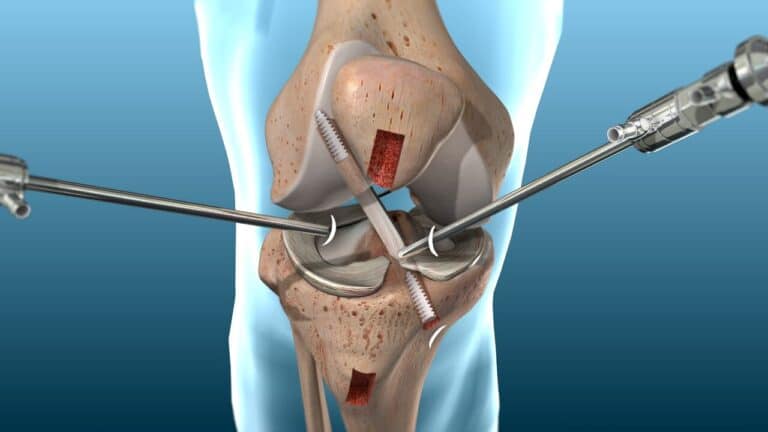
The exact surgical procedure depends on the ligament and joint being treated. ACL reconstruction, for example, is commonly performed using minimally invasive arthroscopic techniques. During ACL reconstruction, the surgeon creates appropriate tunnels in the bones and places a tendon graft to reproduce the function of the damaged ligament. Grafts may come from the patient’s own tissue, known as an autograft, or from donated tissue, known as an allograft. Common autograft sources include the patellar tendon, hamstring tendon, and quadriceps tendon. The graft is securely fixed so that it can provide stability while biological healing and graft maturation take place. The exact graft choice and fixation method depend on factors such as age, activity level, anatomy, previous surgery, associated injuries, and surgeon assessment.
What to Expect Before Surgery
Before sports injury surgery, the orthopaedic team generally reviews the patient’s medical history, symptoms, physical examination findings, and imaging reports. In some cases, physiotherapy may be recommended before surgery to improve knee movement, reduce swelling, and restore muscle control. Having a knee with appropriate range of motion and reduced swelling before surgery can be an important part of preparation for rehabilitation.
Patients may also be advised about medications, fasting requirements, wound care, mobility, crutches, and the expected rehabilitation programme. Understanding the recovery process before surgery can help patients prepare for the weeks and months ahead.
Ligament Reconstruction Surgery Recovery
- Recovery after ligament reconstruction is a gradual process. The exact timeline varies depending on the ligament reconstructed, surgical technique, associated injuries, general health, rehabilitation progress, and individual activity goals.
- After ACL surgery, many patients begin moving and walking with assistance relatively soon after the operation when medically appropriate. Crutches or a brace may be recommended depending on the surgical procedure and the patient’s condition.
- Pain and swelling can be expected during the early recovery period. Elevation, prescribed medication, appropriate icing, wound care, and the rehabilitation programme can help manage these symptoms. Patients should follow the specific instructions provided by their surgeon and physiotherapist.
- Returning to normal activities is not simply a matter of waiting a fixed number of weeks. Strength, movement, balance, coordination, stability, and functional performance are important considerations.
Rehabilitation After Ligament Reconstruction
Rehabilitation after ligament reconstruction is one of the most important parts of recovery. Surgery restores or reconstructs the ligament, but physiotherapy helps the patient gradually regain movement, muscle strength, balance, coordination, and confidence. Early rehabilitation may focus on controlling swelling, restoring knee extension, improving muscle activation, and gradually increasing range of motion. Later stages may involve progressive strengthening, balance exercises, functional movements, running, jumping, and sport-specific activities when appropriate.
For ACL reconstruction, rehabilitation programmes often progress through different stages. Physiotherapy guidance emphasizes restoring quadriceps control, reducing swelling, achieving appropriate range of motion, and gradually improving neuromuscular control. The rehabilitation programme should be individualized. Patients should not increase exercise intensity simply because another person has progressed faster.
Returning to Work and Daily Activities
The time required to return to work depends on the type of job and the extent of the injury and surgery. Someone with a desk-based job may return earlier than someone whose work involves prolonged standing, climbing, lifting, or physically demanding activities. Daily activities should be increased gradually according to medical and physiotherapy advice. Patients may initially require crutches or other support and should avoid movements that place excessive stress on the healing ligament. Following the rehabilitation plan and attending follow-up appointments can help the medical team monitor progress and modify the programme when required. The NHS notes that many people can resume substantial activities within several months after ACL surgery, while returning to sports may take considerably longer.
Returning to Sports After Ligament Reconstruction
- Returning to sport should be approached carefully. Feeling less pain does not necessarily mean that the knee has regained the strength and control required for competitive activity.
- Before returning to sports involving running, jumping, pivoting, or sudden changes in direction, patients may need to demonstrate adequate strength, movement, balance, stability, and functional performance.
- For ACL reconstruction, evidence-based rehabilitation guidance supports criteria-based progression rather than relying only on a fixed number of months. Functional testing can be one part of the return-to-sport decision.
- Some patients may return to sports within six to twelve months after ACL reconstruction, but individual recovery can be shorter or longer. The decision should be made with the treating orthopaedic specialist and physiotherapist based on recovery milestones rather than a calendar date alone.
Possible Risks and Complications
As with any surgical procedure, ligament reconstruction carries potential risks. These may include infection, bleeding, blood clots, stiffness, persistent pain, reduced movement, nerve or blood vessel injury, instability, graft failure, and the need for additional surgery. The risk profile depends on the procedure, the patient’s health, associated injuries, and other factors. Rehabilitation also requires careful progression because excessive loading before adequate healing can interfere with recovery. Patients should contact their medical team if they experience concerning symptoms such as increasing redness or drainage from the surgical wound, fever, severe or worsening pain, significant swelling, calf pain, breathing difficulty, or sudden deterioration in function.
How Can Ligament Injuries Be Prevented?
- Not every ligament injury can be prevented, particularly those caused by unexpected accidents. However, appropriate physical conditioning may reduce injury risk in some sports.
- Strengthening the muscles around the joint, improving balance and coordination, using proper sports techniques, warming up appropriately, and progressing training gradually can support joint function.
- Neuromuscular injury-prevention programmes have been shown to help reduce the risk of some ACL injuries in athletes participating in higher-risk sports.
- Appropriate footwear and safe playing conditions may also be helpful. Athletes should avoid returning to intense sports immediately after an injury and should follow professional guidance for rehabilitation.
Why Choose Specialist Care for Ligament Injuries?
Ligament injuries can vary considerably from one patient to another. A small partial tear, a complete ligament rupture, and a combined ligament-meniscus injury may require very different approaches. Specialist orthopaedic evaluation can help identify the exact injury and determine whether conservative management, physiotherapy, ligament repair surgery, or ligament reconstruction surgery should be considered.
At Mediheal Hospital, patients experiencing knee pain, instability, sports injuries, or suspected ligament tears can seek an orthopaedic evaluation to understand their condition and available treatment options. The treatment plan should be based on the patient’s diagnosis, lifestyle, physical requirements, and recovery goals.
Frequently Asked Questions About Ligament Reconstruction Surgery
What is ligament reconstruction surgery?
Ligament reconstruction surgery is an operation used to restore stability when a damaged ligament is unable to function properly. In procedures such as ACL reconstruction, the damaged ligament is commonly replaced using a tendon graft.
Is ligament reconstruction the same as ligament repair surgery?
No. Repair attempts to preserve and fix the existing ligament, while reconstruction generally creates a new ligament using a graft. For ACL tears requiring surgery, reconstruction is commonly recommended over traditional repair because of evidence regarding revision risk.
Does every ligament tear require surgery?
No. Some ligament injuries can be managed with physiotherapy, activity modification, strengthening, and other non-surgical treatments. Surgery may be considered when instability, injury severity, activity requirements, or associated injuries make reconstruction appropriate.
How long does ligament reconstruction recovery take?
Recovery varies according to the ligament injured, type of surgery, associated injuries, rehabilitation progress, and individual health. ACL recovery can take several months, and returning to sports may take six months or longer. The timeline should be individualized rather than based on a single fixed recovery period.
When can I walk after ligament reconstruction surgery?
Many ACL reconstruction patients begin walking with assistance soon after surgery when medically appropriate. Crutches may be used initially, and weight-bearing instructions depend on the procedure and any additional injuries treated during surgery.
Is physiotherapy necessary after ligament reconstruction?
Yes, rehabilitation is an important part of recovery. Physiotherapy helps restore movement, muscle strength, balance, coordination, and functional ability. Following the prescribed rehabilitation programme can support the recovery process.
Can I return to sports after ligament reconstruction?
Many patients can return to sports after successful rehabilitation, but the timing varies. Before returning to demanding sports, patients generally need adequate strength, stability, movement, balance, and functional control. A healthcare professional should clear the patient for sports participation.
What happens if a ligament injury is left untreated?
The consequences depend on the ligament and severity of the injury. Some patients can function well with non-surgical treatment, while others may experience ongoing instability. Repeated instability may contribute to additional injury to structures such as the meniscus or cartilage in some ACL injuries.
How do I know whether I need ligament surgery?
Persistent joint instability, difficulty returning to desired activities, a complete tear, associated injuries, or failure of appropriate non-surgical treatment may lead an orthopaedic specialist to discuss surgery. An examination and appropriate imaging are needed to determine the right treatment.
Get Orthopaedic Evaluation for a Ligament Injury
A ligament injury should not be ignored if pain, swelling, instability, or difficulty using the joint continues after an injury. Early assessment can help identify the extent of damage and establish an appropriate treatment plan. Whether you need conservative ligament injury treatment, physiotherapy, ligament repair surgery, or ligament reconstruction surgery depends on your individual condition. Proper diagnosis and a structured rehabilitation programme are important for restoring movement and function. If you have experienced a sports injury, accident, knee instability, or symptoms suggesting a torn ligament, consult an orthopaedic specialist at Mediheal Hospital for an evaluation and personalized treatment guidance.